Moz Q&A is closed.
After more than 13 years, and tens of thousands of questions, Moz Q&A closed on 12th December 2024. Whilst we’re not completely removing the content - many posts will still be possible to view - we have locked both new posts and new replies. More details here.
Redirecting an Entire Website?
-
Is it best to redirect an old website to a new website page by page to like pages or just the entire site all at once to the home page of the new site?
I do have about 10 good pages on the site that are worth directing to corresponding pages on the new site. Just trying to figure out what is going to preserve the most link juice.
Thanks for the help!
-
@photoseo1 said in Redirecting an Entire Website?:
Is it best to redirect an old website to a new website page by page to like pages or just the entire site all at once to the home page of the new site?
I do have about 10 good pages on the site that are worth directing to corresponding pages on the new site. Just trying to figure out what is going to preserve the most link juice.Redirecting individual pages to corresponding pages on the new site preserves link juice and ensures seamless user experience.
-
I also want to redirect my client's website blazingweb.site to a new domain name that is more focused on speeding up websites. Is it good to transfer or better to get a new domain name?
-
@photoseo1 Redirecting an entire website involves directing all pages and URLs to new locations or a different domain. It's a strategic decision that requires careful planning and execution. Preserve SEO value and communicate the change effectively.
-
If you redirect your entire website to another website, it will pass the complete link juice to another website and that's the most advantageous thing.
Suppose you have a 30 DA website and some good backlinks..If you redirect it to another website, it will get the same authority and the link juice
-
@Kateparish Thanks so much for the advice.
-
@photoseo1 You need to redirect your whole website to your new URL. Simply do it via your cpanel, and do not forget to check the wildcard option. This will help you to redirect all pages as well.
-
@photoseo1 When redirecting an old website to a new one, it's best to use individual page-to-page redirects for important pages. This preserves link juice and SEO value. It guides search engines and visitors to corresponding pages on the new site. Redirecting the entire site to the new site's homepage is an option for small sites without significant page equivalents. However, it may not retain the same SEO benefits. Targeted page redirects ensure a smooth transition, maintain rankings, and enhance user experience.

Got a burning SEO question?
Subscribe to Moz Pro to gain full access to Q&A, answer questions, and ask your own.
Browse Questions
Explore more categories
-
Moz Tools
Chat with the community about the Moz tools.
-
SEO Tactics
Discuss the SEO process with fellow marketers
-
Community
Discuss industry events, jobs, and news!
-
Digital Marketing
Chat about tactics outside of SEO
-
Research & Trends
Dive into research and trends in the search industry.
-
Support
Connect on product support and feature requests.
Related Questions
-
Redirection of 100 domain to Main domain affects SEO?
Hi guys, An email software vendor managed by a different area of my company redirected 100 domains used for unsolicited email campaigns to my main domain. These domains are very likely to get blacklisted at some point. My SEO tool now is showing me all those domains as "linking" to my main site as do-follow links. The vendor states that this will not affect my main domain/website in any way. I'm highly concerned. I would appreciate your professional opinion about this. Thanks!!
Intermediate & Advanced SEO | | anagentile0 -
What are the SEO ramifications of domain redirection?
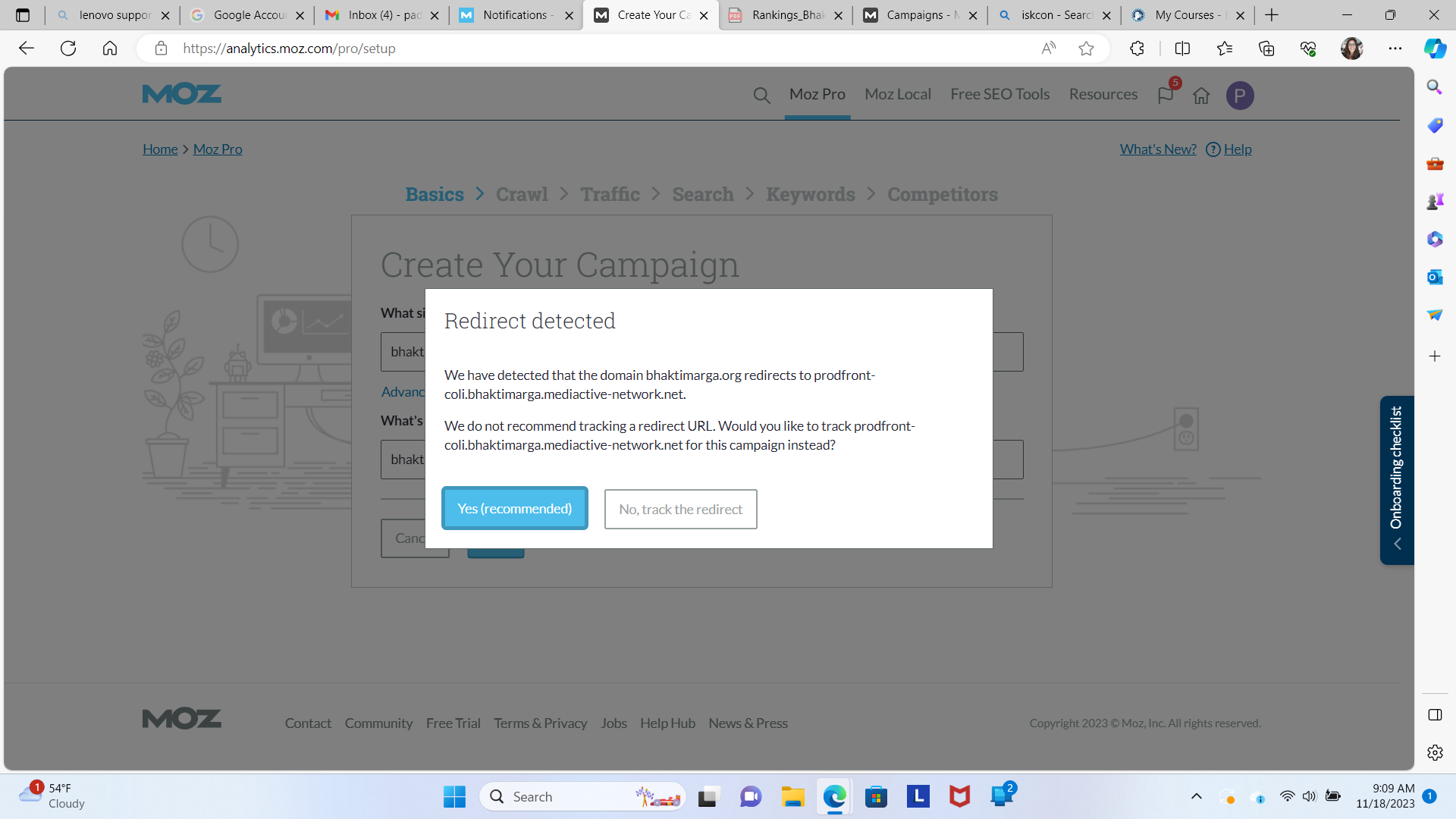
Hi Moz Community! I was just trying to set up our global site and got this message: "Redirect detected
SEO Tactics | | Padmagandhini
We have detected that the domain bhaktimarga.org redirects to prodfront-coli.bhaktimarga.mediactive-network.net. We do not recommend tracking a redirect URL. Would you like to track prodfront-coli.bhaktimarga.mediactive-network.net for this campaign instead?"
6358703c-d8ef-4c0a-83a9-c948d370d743-image.png What's interesting is when you go to the site, Bhaktimarga.org, it shows our domain in the URL bar. Is this done for performance and masks the hosting provider domain? I haven't talked to website developers about this yet, but my main question is...Does this have any SEO ramification? Thanks so much,
Padma0 -
How do you fix redirect chains and temporary redirects?
Hi, I have a lot of issues popping up with temporary redirects and redirect chains. I'm still confused as to what exactly redirect chains are and I don't know how to find where the "chains" are or how to fix them. I'm having two issues mainly:1. Temporary RedirectsI have around 100 pages on our www.twowayradiosfor.com website that are being flagged as temporary redirects. All of them have one thing in common: they are review pages (basically, when a customer clicks on the Review button to review a certain product, they are redirected to a review page for that product).URL Example: https://www.twowayradiosfor.com/reviewhelpful.asp?ProductCode=CLS1410-COMBO&ID=44&yes=noI went into our website and set any URL containing the following as noindex:/review.aspWill that fix the issue? If yes, will I also need to do that for any URL containing /reviewhelpful.asp?2. Redirect ChainsIt seems like basically every product page on my website has this issue (over 100 pages). Here's an example of one:https://www.twowayradiosfor.com/Motorola-CLS1110-p/cls1110.htmI don't see any broken links on this page or links that redirect to another page that redirects, etc. What is causing this? Is it something on my header bar that is redirecting (since that header bar appears on every page, maybe that is why this issue shows up on a lot of pages)?I am new to Moz and still trying to figure this stuff out. I really appreciate any help. Thanks, Sawyer
Technical SEO | | AllChargedUp0 -
Is there a limit to Internal Redirect?
I know Google says there is no limit to it but I have seen on many websites that too many 301 redirects can be a problem and might negatively affect your rankings in SERPs. I wanted to know especially from people who worked on large ecommerce site. How do they manage internal redirect from one URL to other and how many according to you are too many. I mean if you get a website that contain 300 plus 301 redirections within the website, how will you deal with that? Please let me know if the question is not clear.
Technical SEO | | MoosaHemani0 -
DNS vs IIS redirection
I'm working on a project where a site has gone through a rebrand and is therefore also moving to a new domain name. Some pages have been merged on the new site so it's not a lift and shift job and so I'm writing up a redirect plan. Their IT dept have asked if we want redirects done by DNS redirect or IIS redirect. Which one will allow us to have redirects on a page level and not a domain level? I think IIS may be the right route but would love your thoughts on this please.
Technical SEO | | Marketing_Today1 -
403 forbidden error website
Hi Mozzers, I got a question about new website from a new costumer http://www.eindexamensite.nl/. There is a 403 forbidden error on it, and I can't find what the problem is. I have checked on: http://gsitecrawler.com/tools/Server-Status.aspx
Technical SEO | | MaartenvandenBos
result:
URL=http://www.eindexamensite.nl/ **Result code: 403 (Forbidden / Forbidden)** When I delete the .htaccess from the server there is a 200 OK :-). So it is in the .htaccess. .htaccess code: ErrorDocument 404 /error.html RewriteEngine On
RewriteRule ^home$ / [L]
RewriteRule ^typo3$ - [L]
RewriteRule ^typo3/.$ - [L]
RewriteRule ^uploads/.$ - [L]
RewriteRule ^fileadmin/.$ - [L]
RewriteRule ^typo3conf/.$ - [L]
RewriteCond %{REQUEST_FILENAME} !-f
RewriteCond %{REQUEST_FILENAME} !-d
RewriteCond %{REQUEST_FILENAME} !-l
RewriteRule .* index.php Start rewrites for Static file caching RewriteRule ^(typo3|typo3temp|typo3conf|t3lib|tslib|fileadmin|uploads|screens|showpic.php)/ - [L]
RewriteRule ^home$ / [L] Don't pull *.xml, *.css etc. from the cache RewriteCond %{REQUEST_FILENAME} !^..xml$
RewriteCond %{REQUEST_FILENAME} !^..css$
RewriteCond %{REQUEST_FILENAME} !^.*.php$ Check for Ctrl Shift reload RewriteCond %{HTTP:Pragma} !no-cache
RewriteCond %{HTTP:Cache-Control} !no-cache NO backend user is logged in. RewriteCond %{HTTP_COOKIE} !be_typo_user [NC] NO frontend user is logged in. RewriteCond %{HTTP_COOKIE} !nc_staticfilecache [NC] We only redirect GET requests RewriteCond %{REQUEST_METHOD} GET We only redirect URI's without query strings RewriteCond %{QUERY_STRING} ^$ We only redirect if a cache file actually exists RewriteCond %{DOCUMENT_ROOT}/typo3temp/tx_ncstaticfilecache/%{HTTP_HOST}/%{REQUEST_URI}/index.html -f
RewriteRule .* typo3temp/tx_ncstaticfilecache/%{HTTP_HOST}/%{REQUEST_URI}/index.html [L] End static file caching DirectoryIndex index.html CMS is typo3. any ideas? Thanks!
Maarten0 -
Do search engines treat 307 redirects differently from 302 redirects?
We will need to send our users to an alternate version of our homepage for a few hours for a certain event. The SEO task at hand is to minimize the chance of the special homepage getting crawled and cached in the search engines in place of our normal homepage. (This has happened in the past so the concern is not imaginary.) Among other options, 302 and 307 redirects are being discussed. IE, redirecting www.domain.com to www.domain.com/specialpage. Having used 302s and 301s in the past, I am well aware of how search engines treat them. A 302 effectively says "Hey, Google! Please get rid of the old content on www.domain.com and replace it with the content on /specialpage!" Which is exactly what we don't want. My question is: do the search engines handle 307s any differently? I am hearing that the 307 does NOT result in the content of the second page being cached with the first URL. But I don't see that in the definition below (from w3.org). Then again, why differentiate it from the 302? 307 Temporary Redirect The requested resource resides temporarily under a different URI. Since the redirection MAY be altered on occasion, the client SHOULD continue to use the Request-URI for future requests. This response is only cacheable if indicated by a Cache-Control or Expires header field. The temporary URI SHOULD be given by the Location field in the response. Unless the request method was HEAD, the entity of the response SHOULD contain a short hypertext note with a hyperlink to the new URI(s) , since many pre-HTTP/1.1 user agents do not understand the 307 status. Therefore, the note SHOULD contain the information necessary for a user to repeat the original request on the new URI. If the 307 status code is received in response to a request other than GET or HEAD, the user agent MUST NOT automatically redirect the request unless it can be confirmed by the user, since this might change the conditions under which the request was issued.
Technical SEO | | CarsProduction0 -
If a redirecting URL has more value than the website should I move it?
Client has two website addresses: Website A is a redirect to Website B. It has one indexed page. But this is the URL being used in collateral. It has the majority of back links, and citations everywhere list Website A as the URL. Website B is where the actual website lives. Google recognizes and indexes the 80+ pages. This website has very few backlinks going to it. This setup does not seem good for SEO. Moreover, the analytics data is completely messed up because Website B shows that the biggest referral source is... you guessed it Website A. I'm thinking going forward, I should: Move all the content from Website B to Website A. Setup Website B to permanently 301 Redirect to Website A. Is that the best course of action?
Technical SEO | | flowsimple0