Moz Q&A is closed.
After more than 13 years, and tens of thousands of questions, Moz Q&A closed on 12th December 2024. Whilst we’re not completely removing the content - many posts will still be possible to view - we have locked both new posts and new replies. More details here.
Schema Markup Warning "Missing field "url" (optional)"
-
Hello Moz Team, I hope everyone is doing well & good,
I need bit help regarding Schema Markup, I am facing issue in my schema markup specifically with my blog posts,
In my majority of the posts I find error "Missing field "url" (optional)"
As this schema is generated by Yoast plugin, I haven't applied any custom steps.Recently I published a post
https://dailycontributors.com/kisscartoon-alternatives-and-complete-review/
and I tested it at two platforms of schema test
1, Validator.Schema.org
2. Search.google.com/test/rich-resultsSo the validator generate results as follows and shows no error
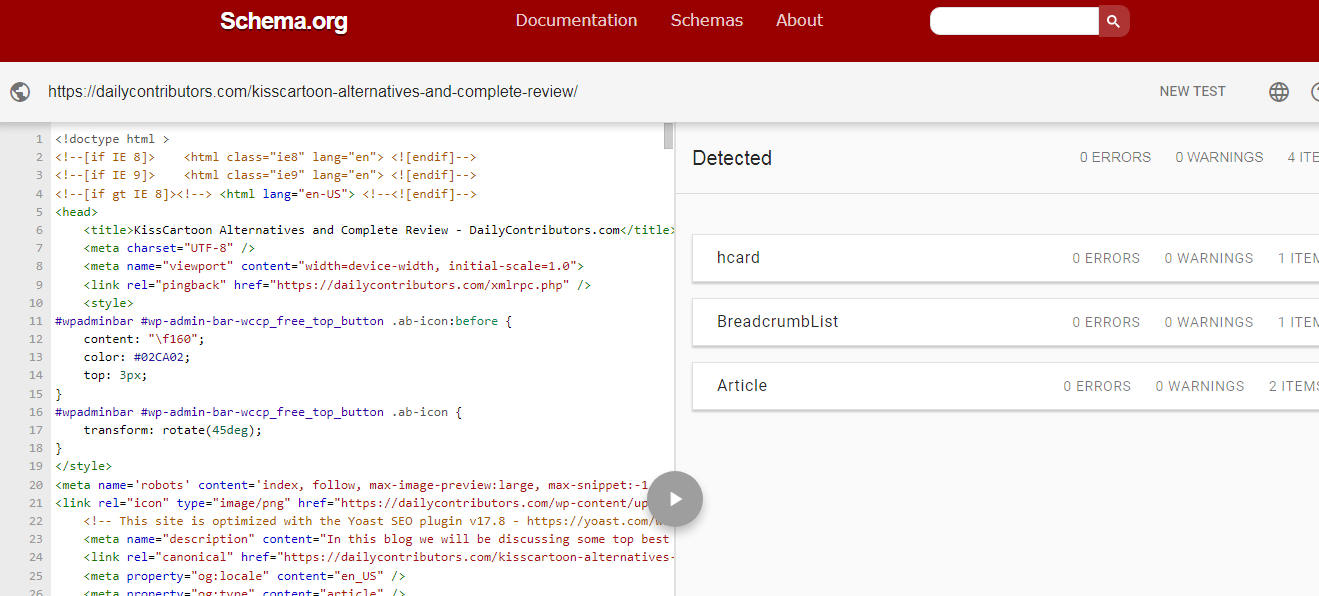
It shows no error
But where as
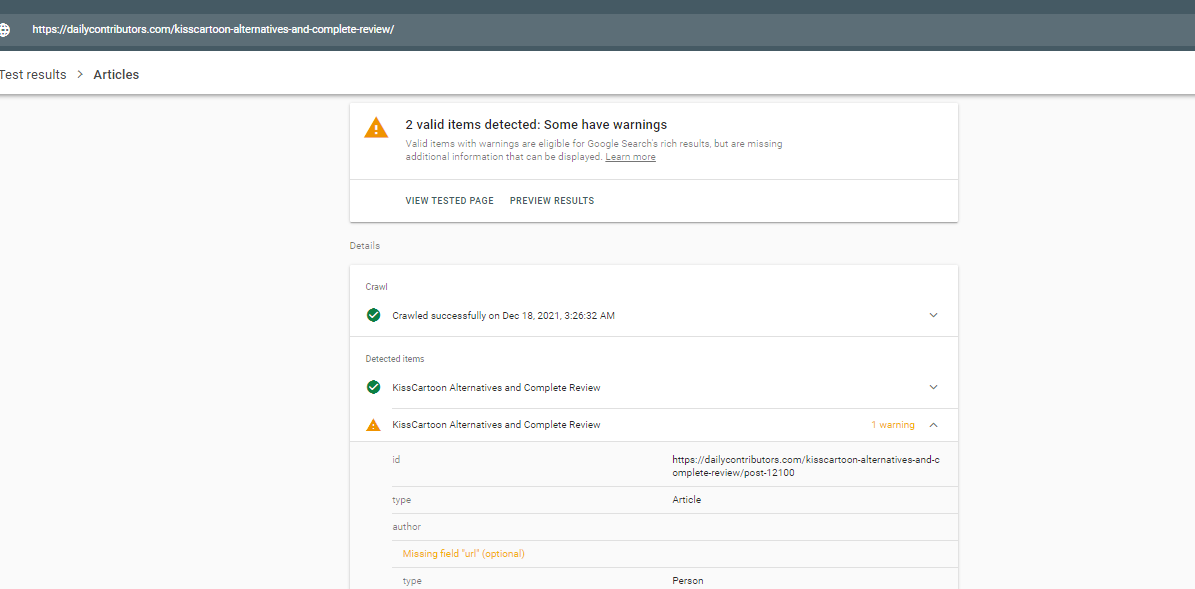
in search central results it gives me a warning "Missing field "url" (optional)".
So is this really be going to issue for my ranking ? Please help thanks!
-
@JoeySolicitor I thinks , My website sam with your issue

Got a burning SEO question?
Subscribe to Moz Pro to gain full access to Q&A, answer questions, and ask your own.
Browse Questions
Explore more categories
-
Moz Tools
Chat with the community about the Moz tools.
-
SEO Tactics
Discuss the SEO process with fellow marketers
-
Community
Discuss industry events, jobs, and news!
-
Digital Marketing
Chat about tactics outside of SEO
-
Research & Trends
Dive into research and trends in the search industry.
-
Support
Connect on product support and feature requests.
Related Questions
-
Unsolved Duplicate LocalBusiness Schema Markup
Hello! I've been having a hard time finding an answer to this specific question so I figured I'd drop it here. I always add custom LocalBusiness markup to clients' homepages, but sometimes the client's website provider will include their own automated LocalBusiness markup. The codes I create often include more information. Assuming the website provider is unwilling to remove their markup, is it a bad idea to include my code as well? It seems like it could potentially be read as spammy by Google. Do the pros of having more detailed markup outweigh that potential negative impact?
Local Website Optimization | | GoogleAlgoServant0 -
Schema Markup Validator vs. Rich Results Test
I am working on a schema markup project. When I test the schema code in the Schema Markup Validator, everything looks fine, no errors detected. However, when I test it in the Rich Results Test, a few errors come back.
Intermediate & Advanced SEO | | Collegis_Education
What is the difference between these two tests? Should I trust one over the other?1 -
Looking for live web examples of Medical schema
Has anyone seen a hospital system or medical clinic properly employ schema markup to their sites? This seems like very new territory, and we want to do it right by our client. Are there any best practices I need to look out for?
Web Design | | Madgenius3 -
"5XX (Server Error)" - How can I fix this?
Hey Mozers! Moz Crawl tells me I am having an issue with my Wordpress category - it is returning a 5XX error and i'm not sure why? Can anyone help me determine the issue? Crawl Issues and Notices for: http://www.refusedcarfinance.com/news/category/news We found 1 crawler issue(s) for this page. High Priority Issues 1 5XX (Server Error) 5XX errors (e.g., a 503 Service Unavailable error) are shown when a valid request was made by the client, but the server failed to complete the request. This can indicate a problem with the server, and should be investigated and fixed.
Technical SEO | | RocketStats0 -
Schema Markup Errors - Priority or Not?
Greetings All... I've been digging through the search console on a few of my sites and I've been noticing quite a few structured data errors. Most of the errors are related to: hcard, hentry and hatom. Most of them are missing author & entry-title, while the other one is missing: fn. I recently saw an article on SEL about Google's focus on spammy mark-up. The sites I use are built and managed by vendors, so I would have to impress upon them the impact of these errors and have them prioritize, then fix them. My question is whether or not this should be prioritized? Should I have them correct these errors sooner than later or can I take a phased approach? I haven't noticed any loss in traffic or anything like that, I'm more focused on what negative impact a "phased approach" could have. Any thoughts?
Technical SEO | | AfroSEO0 -
How Does Google's "index" find the location of pages in the "page directory" to return?
This is my understanding of how Google's search works, and I am unsure about one thing in specific: Google continuously crawls websites and stores each page it finds (let's call it "page directory") Google's "page directory" is a cache so it isn't the "live" version of the page Google has separate storage called "the index" which contains all the keywords searched. These keywords in "the index" point to the pages in the "page directory" that contain the same keywords. When someone searches a keyword, that keyword is accessed in the "index" and returns all relevant pages in the "page directory" These returned pages are given ranks based on the algorithm The one part I'm unsure of is how Google's "index" knows the location of relevant pages in the "page directory". The keyword entries in the "index" point to the "page directory" somehow. I'm thinking each page has a url in the "page directory", and the entries in the "index" contain these urls. Since Google's "page directory" is a cache, would the urls be the same as the live website (and would the keywords in the "index" point to these urls)? For example if webpage is found at wwww.website.com/page1, would the "page directory" store this page under that url in Google's cache? The reason I want to discuss this is to know the effects of changing a pages url by understanding how the search process works better.
Technical SEO | | reidsteven750 -
Drupal URL Aliases vs 301 Redirects + Do URL Aliases create duplicates?
Hi all! I have just begun work on a Drupal site which heavily uses the URL Aliases feature. I fear that it is creating duplicate links. For example:: we have http://www.URL.com/index.php and http://www.URL.com/ In addition we are about to switch a lot of links and want to keep the search engine benefit. Am I right in thinking URL aliases change the URL, while leaving the old URL live and without creating search engine friendly redirects such as 301s? Thanks for any help! Christian
Technical SEO | | ChristianMKTG0 -
Meta tag "noindex,nofollow" by accident
Hi, 3 weeks ago I wanted to release a new website (made in WordPress), so I neatly created 301 redirects for all files and folders of my old html website and transferred the WordPress site into the index folder. Job well done I thought, but after a few days, my site suddenly disappeared from google. I read in other Q&A's that this could happen so I waited a little longer till I finally saw today that there was a meta robots added on every page with "noindex, nofollow". For some reason, the WordPress setting "I want to forbid search engines, but allow normal visitors to my website" was selected, although I never even opened that section called "Privacy". So my question is, will this have a negative impact on my pagerank afterwards? Thanks, Sven
Technical SEO | | Zitana0