Moz Q&A is closed.
After more than 13 years, and tens of thousands of questions, Moz Q&A closed on 12th December 2024. Whilst we’re not completely removing the content - many posts will still be possible to view - we have locked both new posts and new replies. More details here.
Can Google Read schema.org markup within Ajax?
-
Hi All,
as a local business directory, we also display Openinghours on a business listing page. ex. http://www.goudengids.be/napoli-kontich-2550/
At the same time I also have schema.org markup for Openinghours implemented.
But, for technical reasons (performance), the openinghours (and the markup alongside) are displayed using AJAX.I'm wondering if google is able to read the markup. The rich snippet tool and markup plugings like Semantic Inspector can't "see" the markup for openinghours.
Any advice here?
-
So if you read around on the topic Google supporting AJAX is a recent development so there are still many issues, with this. Think of it this way if Google bots still have a hard time reading regular code after so many years now. AJAX will have issues, they are focusing from what it seems on commenting systems such as FB, and Disqus. However try it out and see if your AJAX is being read if not it might be some time before most of the AJAX crawling works as it should.
Hope this helps
More info: http://searchengineland.com/google-can-now-execute-ajax-javascript-for-indexing-99518
-
If i am not mistaken, this is what you are looking for?



Got a burning SEO question?
Subscribe to Moz Pro to gain full access to Q&A, answer questions, and ask your own.
Browse Questions
Explore more categories
-
Moz Tools
Chat with the community about the Moz tools.
-
SEO Tactics
Discuss the SEO process with fellow marketers
-
Community
Discuss industry events, jobs, and news!
-
Digital Marketing
Chat about tactics outside of SEO
-
Research & Trends
Dive into research and trends in the search industry.
-
Support
Connect on product support and feature requests.
Related Questions
-

Schema Markup Warning "Missing field "url" (optional)"
Hello Moz Team, I hope everyone is doing well & good, I need bit help regarding Schema Markup, I am facing issue in my schema markup specifically with my blog posts, In my majority of the posts I find error "Missing field "url" (optional)"
Technical SEO | | JoeySolicitor
As this schema is generated by Yoast plugin, I haven't applied any custom steps. Recently I published a post https://dailycontributors.com/kisscartoon-alternatives-and-complete-review/ and I tested it at two platforms of schema test 1, Validator.Schema.org
2. Search.google.com/test/rich-results So the validator generate results as follows and shows no error
Schema without error.PNG It shows no error But where as Schema with error.PNG in search central results it gives me a warning "Missing field "url" (optional)". So is this really be going to issue for my ranking ? Please help thanks!6 -

Product Schema Markup for All Products
Hi Team, Google search console used to allow you to use their structured data markup helperhttps://www.google.com/webmasters/markup-helper/u/0/ to markup multiple product pages at once that were similar. I do not see this feature anymore with the new search console. Does anyone have a recommendation for marking up multiple product pages without having to have schema markup firing in GTM for each product page?
Technical SEO | | agrier0 -

What punctuation can you use in meta tags? Are there any Google does not like?
So I know you can use dashes and | in meta tags, but can anyone tell me what other punctuation you can use? Also, it'd be great to know what punctuation you can't use. Thanks!
Technical SEO | | Trevorneo1 -

Schema markup for products is missing "price": Is this bad?
Hey guys, So a current client of mine has an e-commerce shop with a few hundred products. They purposely choose to keep the prices off of their website, which is causing errors in Google Webmaster Tools. Basically the error shows: Error: Structured Data > Product (markup: schema.org) Error type: missing price 208 items with error Is this a huge deal? Or are we allowed to have non-numerical prices for schema ie. "call for quote"
Technical SEO | | tbinga1 -
Image Indexing Issue by Google
Hello All,My URL is: www.thesalebox.comI have Submitted my image Sitemap in google webmaster tool on 10th Oct 2013,Still google could not indexing any of my web images,Please refer my sitemap - www.thesalebox.com/AppliancesHomeEntertainment.xml and www.thesalebox.com/Hardware.xmland my webmaster status and image indexing status are below,
Technical SEO | | CommercePundit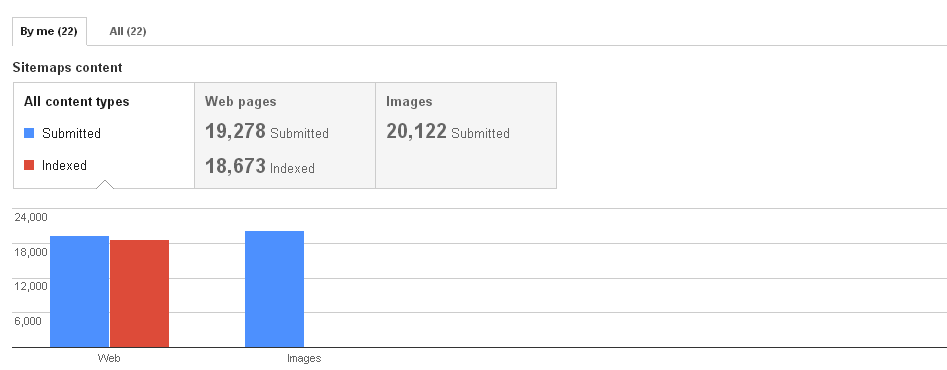 Can you please help me, why my images are not indexing in google yet? is there any issue? please give me suggestions?Thanks!
0
Can you please help me, why my images are not indexing in google yet? is there any issue? please give me suggestions?Thanks!
0 -

Google is indexing my directories
I'm sure this has been asked before, but I was looking at all of Google's results for my site and I found dozens of results for directories such as: Index of /scouting/blog/wp-includes/js/swfupload/plugins Obviously I don't want those indexed. How do I prevent Google from indexing those? Also, it only seems to be doing it with Wordpress, not any of the directories on my main site. (We have a wordpress blog, which is only a portion of the site)
Technical SEO | | UnderRugSwept0 -

Tags showing up in Google
Yesterday a user pointed out to me that Tags were being indexed in Google search results and that was not a good idea. I went into my Yoast settings and checked the "nofollow, index" in my Taxanomies, but when checking the source code for no follow, I found nothing. So instead, I went into the robot.txt and disallowed /tag/ Is that ok? or is that a bad idea? The site is The Tech Block for anyone interested in looking.
Technical SEO | | ttb0 -

Can you mark up a page using Schema.org and Facebook Open Graph?
Is it possible to use both Schema.org and Facebook Open Graph for structured data markup? On the Google Webmaster Central blog, they say, "you should avoid mixing the formats together on the same web page, as this can confuse our parsers." Source - http://googlewebmastercentral.blogspot.com/2011/06/introducing-schemaorg-search-engines.html
Technical SEO | | SAMarketing1
