Moz Q&A is closed.
After more than 13 years, and tens of thousands of questions, Moz Q&A closed on 12th December 2024. Whilst we’re not completely removing the content - many posts will still be possible to view - we have locked both new posts and new replies. More details here.
MBG Tracker...how to use it?
-
So I am a new blogger that has been submitting guest blog posts to a number of different blogs. It was recommended that I use the MBG Tracker so I can track the back links. The problem is that I am totally lost on how to use this tool. As I said before I am new to this whole thing and I am not really sure what constitutes a "base link" and a "back link." In the author bylines we are linking to different pages within a larger website. If anyone can help me I would really appreciate it!
-
Thanks for the reply Ann! David, SEOmoz and MyBlogGuest are different products, you'll probably find the best help for MBG talking with Ann or using her support forums.
-
Let me try to be very clear. Please email if you have more questions (I got both of your emails, so feel free to use the email)
When guest blogging, are you promoting ONE site in your byline in each of the guest posts? There can be different pages from one site, but one and the same domain.
For example:
- Project name: SEOmoz
- Base domain: seomoz.org
Then when you decide to upload this page, for example: http://www.geekwire.com/2012/seomoz-secret-startup-success-rand-fishkins-tips/ - the tracker will automatically identify the backlink to track - http://www.seomoz.org/dp/seattle-startup-marketing - because it has seomoz.org base domain.
By providing the base domain, you make your own job easier because you don't have to manually provide the tool with the backlink to track!
-
So the base link would be the link to the blog post and the back link is the link that goes back to my site? Is this correct? I had seen the site that you suggested but like I said I was confused by the base link and the back link.
-
Base link is a normal submission with a link. Back link has more value with guest blogging.
HOW DOES THE BACKLINK MONITORING TOOL WORK?
This is the cheapest and simplest alternative I am aware of:
- Receive instant emails if any of your links were removed or nofollowed;
- Track your guest post social popularity (Likes and Tweets)
- Measure traffic from each of your guest posts (for that you’ll need to install a tracking code)
- Identify most efficient backlink sources (for example, to find places where you canguest post again).
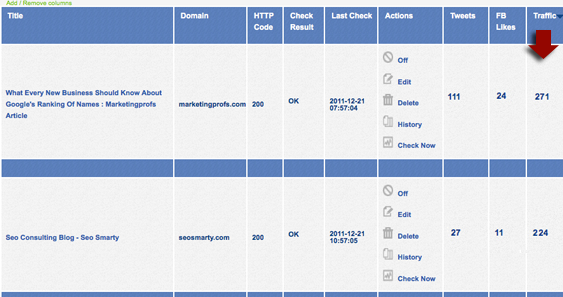
To start tracking your guest posts or links, you’ll need to create a new project and specify your base URL. For all pages you add within one project, this very base URL will be monitored automatically (even if you don’t specify which link within a given page you want to track).
You can add / remove columns from the table (to adjust a clearer view) and sort by each column. You will also receive weekly summaries of your missing links and most popular link sources.
Handy url for more info..... http://www.seosmarty.com/meet-mbg-tracker-the-simplest-and-cheapest-way-to-monitor-your-backlinks/
Got a burning SEO question?
Subscribe to Moz Pro to gain full access to Q&A, answer questions, and ask your own.
Browse Questions
Explore more categories
-
Moz Tools
Chat with the community about the Moz tools.
-
SEO Tactics
Discuss the SEO process with fellow marketers
-
Community
Discuss industry events, jobs, and news!
-
Digital Marketing
Chat about tactics outside of SEO
-
Research & Trends
Dive into research and trends in the search industry.
-
Support
Connect on product support and feature requests.
Related Questions
-
What do you do with product pages that are no longer used ? Delete/redirect to category/404 etc
We have a store with thousands of active items and thousands of sold items. Each product is unique so only one of each. All products are pinned and pushed online ... and then they sell and we have a product page for a sold item. All products are keyword researched and often can rank well for longtail keywords Would you :- 1. delete the page and let it 404 (we will get thousands) 2. See if the page has a decent PA, incoming links and traffic and if so redirect to a RELEVANT category page ? ~(again there will be thousands) 3. Re use the page for another product - for example a sold ruby ring gets replaces with ta new ruby ring and we use that same page /url for the new item. Gemma
Technical SEO | | acsilver0 -
Using 410 To Remove URLs Starting With Same Word
We had a spam injection a few months ago. We successfully cleaned up the site and resubmitted to google. I recently received a notification showing a spike in 404 errors. All of the URLS have a common word at the beginning injected via the spam: sitename.com/mono
Technical SEO | | vikasnwu
sitename.com/mono.php?buy-good-essays
sitename.com/mono.php?professional-paper-writer There's about 100 total URLS with the same syntax with the word "mono" in them. Based on my research, it seems that it would be best to serve a 410. I wanted to know what the line of HTACCESS code would be to do that in bulk for any URL that has the word "mono" after the sitename.com/0 -
Canonical issues using Screaming Frog and other tools?
In the Directives tab within Screaming Frog, can anyone tell me what the difference between "canonicalised", "canonical", and "no canonical" means? They're found in the filter box. I see the data but am not sure how to interpret them. Which one of these would I check to find canonical issues within a website? Are there any other easy ways to identify canonical issues?
Technical SEO | | Flock.Media0 -
302 redirect used, submit old sitemap?
The website of a partner of mine was recently migrated to a new platform. Even though the content on the pages mostly stayed the same, both the HTML source (divs, meta data, headers, etc.) and URLs (removed index.php, removed capitalization, etc) changed heavily. Unfortunately, the URLs of ALL forum posts (150K+) were redirected using a 302 redirect, which was only recently discovered and swiftly changed to a 301 after the discovery. Several other important content pages (150+) weren't redirected at all at first, but most now have a 301 redirect as well. The 302 redirects and 404 content pages had been live for over 2 weeks at that point, and judging by the consistent day/day drop in organic traffic, I'm guessing Google didn't like the way this migration went. My best guess would be that Google is currently treating all these content pages as 'new' (after all, the source code changed 50%+, most of the meta data changed, the URL changed, and a 302 redirect was used). On top of that, the large number of 404's they've encountered (40K+) probably also fueled their belief of a now non-worthy-of-traffic website. Given that some of these pages had been online for almost a decade, I would love Google to see that these pages are actually new versions of the old page, and therefore pass on any link juice & authority. I had the idea of submitting a sitemap containing the most important URLs of the old website (as harvested from the Top Visited Pages from Google Analytics, because no old sitemap was ever generated...), thereby re-pointing Google to all these old pages, but presenting them with a nice 301 redirect this time instead, hopefully causing them to regain their rankings. To your best knowledge, would that help the problems I've outlined above? Could it hurt? Any other tips are welcome as well.
Technical SEO | | Theo-NL0 -
Does using data-href="" work more effectively than href="" rel="nofollow"?
I've been looking at some bigger enterprise sites and noticed some of them used HTML like this: <a <="" span="">data-href="http://www.otherodmain.com/" class="nofollow" rel="nofollow" target="_blank"></a> <a <="" span="">Instead of a regular href="" Does using data-href and some javascript help with shaping internal links, rather than just using a strict nofollow?</a>
Technical SEO | | JDatSB0 -
Use of title tags on divs for SEO purposes
Hello community, I recently was asked by a client to analyze a website of a competitor. I did was he asked me to do but when I looked at the source code of the website I found this code: I changed the exact words into something for privacy reasons, but I never looked at a code like this.
Technical SEO | | JarnoNijzing
Using a div for an anchor I get but adding a title tag to the div? I never seen that before. Title tags on anchors, yes, using images in divs as background and then adding a title??? Does anyone have any experience with a code like this and if you do how does this impact rankings? Does it impact rankings at all and does anybody know of any correlation between the two? Looking forward for your responses. Regards Jarno0 -
Does using parentheses affect the crawlers?
Quick question: if you using a parantheses around a keyword, do search bots still recognize the keyword? Fox ex: Welcome to a website about the National Basketball Association (NBA). Will the bots recognize that I'm trying to optimize to NBA and not (NBA)? Is this different for tags vs. actual body copy?
Technical SEO | | BPIAnalytics2 -
Use of Meta Tag - MSSmartTagsPreventParsing
We've inherited some sites from another developer that had the following tag: All references I can find to it are from 2004. What is the purpose and is it worth including in pages/sites we build?
Technical SEO | | wcksmith0