Moz Q&A is closed.
After more than 13 years, and tens of thousands of questions, Moz Q&A closed on 12th December 2024. Whilst we’re not completely removing the content - many posts will still be possible to view - we have locked both new posts and new replies. More details here.
How to index e-commerce marketplace product pages
-
Hello!
We are an online marketplace that submitted our sitemap through Google Search Console 2 weeks ago. Although the sitemap has been submitted successfully, out of ~10000 links (we have ~10000 product pages), we only have 25 that have been indexed.
I've attached images of the reasons given for not indexing the platform.
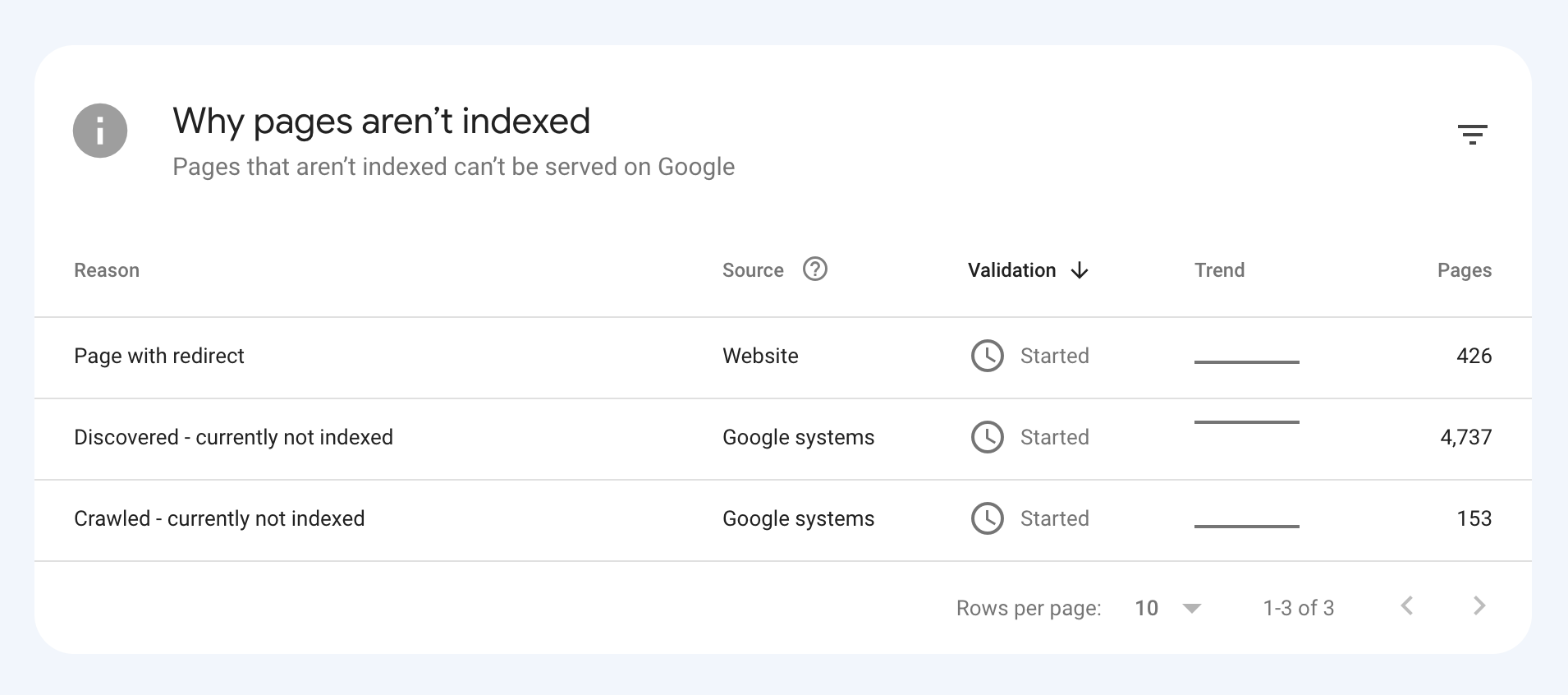
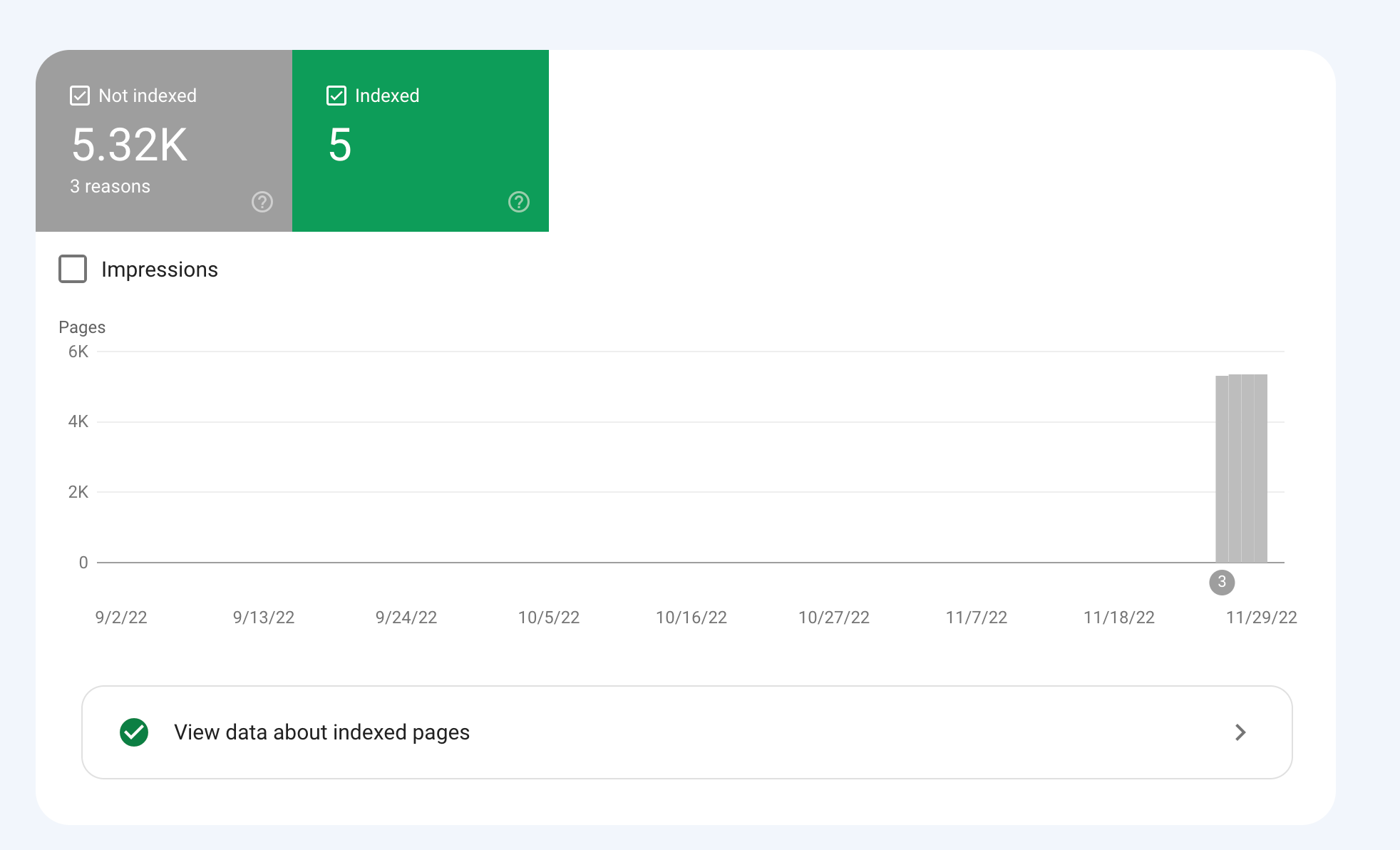
How would we go about fixing this?
-
To get your e-commerce marketplace product pages indexed, make sure your pages include unique and descriptive titles, meta descriptions, relevant keywords, and high-quality images. Additionally, optimize your URLs, leverage schema markup, and prioritize user experience for increased search engine visibility.
-
@fbcosta i hve this problem but its so less in my site
پوشاک پاپیون -
I'd appreciate if someone who faced the same indexing issue comes forward and share the case study with fellow members. Pin points steps a sufferer should do to overcome indexing dilemma. What actionable steps to do to enable quick product indexing? How we can get Google's attention so it can start indexing pages at a quick pace? Actionable advice please.
-
There could be several reasons why only 25 out of approximately 10,000 links have been indexed by Google, despite successfully submitting your sitemap through Google Search Console:
Timing: It is not uncommon for indexing to take some time, especially for larger sites with many pages. Although your sitemap has been submitted, it may take several days or even weeks for Google to crawl and index all of your pages. It's worth noting that not all pages on a site may be considered important or relevant enough to be indexed by Google.
Quality of Content: Google may not index pages that it considers low-quality, thin or duplicate content. If a significant number of your product pages have similar or duplicate content, they may not be indexed. To avoid this issue, make sure your product pages have unique, high-quality content that provides value to users.
Technical issues: Your site may have technical issues that are preventing Google from crawling and indexing your pages. These issues could include problems with your site's architecture, duplicate content, or other issues that may impact crawling and indexing.
Inaccurate Sitemap: There is also a possibility that there are errors in the sitemap you submitted to Google. Check the sitemap to ensure that all the URLs are valid, the sitemap is up to date and correctly formatted.
To troubleshoot this issue, you can check your site's coverage report on Google Search Console, which will show you which pages have been indexed and which ones haven't. You can also check your site's crawl report to see if there are any technical issues that may be preventing Google from crawling your pages. Finally, you can also run a site audit to identify and fix any technical issues that may be impacting indexing.
-
@fbcosta As per my experience, if your site is new it will take some time to index all of the URLs, and the second thing is, if you have Hundreds of URLs, it doesn't mean Google will index all of them.
You can try these steps which will help in fast indexing:
- Sharing on Social Media
- Interlinking from already indexed Pages
- Sitemap
- Share the link on the verified Google My Business Profile (Best way to index fast). You can add by-products or create a post and link it to the website.
- Guest post
I am writing here for the first time, I hope it will help

Got a burning SEO question?
Subscribe to Moz Pro to gain full access to Q&A, answer questions, and ask your own.
Browse Questions
Explore more categories
-
Moz Tools
Chat with the community about the Moz tools.
-
SEO Tactics
Discuss the SEO process with fellow marketers
-
Community
Discuss industry events, jobs, and news!
-
Digital Marketing
Chat about tactics outside of SEO
-
Research & Trends
Dive into research and trends in the search industry.
-
Support
Connect on product support and feature requests.
Related Questions
-
Requiring customer agree to shipping terms at checkout
I work for an ecommerce company that has many of its shipments go by LTL freight. Our customer service team has issues with a few customers per month that aren't equipped to receive freight shipments which leads to returns and other issues. In an effort to better inform our customers, the customer service team is requesting that we add a checkbox to the checkout that requires customers to agree to our shipping and returns policy, including a link to the policy page. I am wondering how concerned people here would be that requiring the customer to check a box agreeing to those terms would lead to more customers abandoning during the checkout process. Or do you think it's not a concern? Thanks for your thoughts.
Conversion Rate Optimization | | Kyle_M0 -
Collections or blog posts for Shopify ecommerce seo?
Hi, hope you guys can help as I am going down a rabbit hole with this one! We have a solid-ranking sports nutrition site and are building a new SEO keyword strategy on our Shopify built store. We are using collections (categories) for much of the key product-based seo. This is because, as we understand it, Google prioritises collection/category pages over product pages. Should we then build additional collection pages to rank for secondary product search terms that could fit a collection page structure (eg 'vegan sports nutrition'), or should we use blog posts to do this? We have a quality blog with good unique content and reasonable domain authority so both options are open to us. But while the collection/category option may be best for SEO, too many collections/categories could upset our UX. We have a very small product range (10 products) so want to keep navigation fast and easy. Our 7 lead keyword collection pages do this already. More run the risk of upsetting ease/speed of site navigation. On the other hand, conversion rate from collection pages is historically much better than blog pages. We have made major technical upgrades to the blog to improve this but these are yet to be tested in anger. So at the heart of it all - do you guys recommend favouring blog posts or collection/category pages for secondary high sales intent keywords? All help gratefully received - thanks!
SEO Tactics | | WP332 -
Solved How to solve orphan pages on a job board
Working on a website that has a job board, and over 4000 active job ads. All of these ads are listed on a single "job board" page, and don’t obviously all load at the same time. They are not linked to from anywhere else, so all tools are listing all of these job ad pages as orphans. How much of a red flag are these orphan pages? Do sites like Indeed have this same issue? Their job ads are completely dynamic, how are these pages then indexed? We use Google’s Search API to handle any expired jobs, so they are not the issue. It’s the active, but orphaned pages we are looking to solve. The site is hosted on WordPress. What is the best way to solve this issue? Just create a job category page and link to each individual job ad from there? Any simpler and perhaps more obvious solutions? What does the website structure need to be like for the problem to be solved? Would appreciate any advice you can share!
Reporting & Analytics | | Michael_M2 -
How to stop google from indexing specific sections of a page?
I'm currently trying to find a way to stop googlebot from indexing specific areas of a page, long ago Yahoo search created this tag class=”robots-nocontent” and I'm trying to see if there is a similar manner for google or if they have adopted the same tag? Any help would be much appreciated.
Technical SEO | | Iamfaramon0 -
How to stop my webmail pages not to be indexed on Google ??
when i did a search in google for Site:mywebsite.com , for a list of pages indexed. Surprisingly the following come up " Webmail - Login " Although this is associated with the domain , this is a completely different server , this the rackspace email server browser interface I am sure that there is nothing on the website that links or points to this.
Technical SEO | | UIPL
So why is Google indexing it ? & how do I get it out of there. I tried in webmaster tool but I could not , as it seems like a sub-domain. Any ideas ? Thanks Naresh Sadasivan0 -
De-indexing millions of pages - would this work?
Hi all, We run an e-commerce site with a catalogue of around 5 million products. Unfortunately, we have let Googlebot crawl and index tens of millions of search URLs, the majority of which are very thin of content or duplicates of other URLs. In short: we are in deep. Our bloated Google-index is hampering our real content to rank; Googlebot does not bother crawling our real content (product pages specifically) and hammers the life out of our servers. Since having Googlebot crawl and de-index tens of millions of old URLs would probably take years (?), my plan is this: 301 redirect all old SERP URLs to a new SERP URL. If new URL should not be indexed, add meta robots noindex tag on new URL. When it is evident that Google has indexed most "high quality" new URLs, robots.txt disallow crawling of old SERP URLs. Then directory style remove all old SERP URLs in GWT URL Removal Tool This would be an example of an old URL:
Technical SEO | | TalkInThePark
www.site.com/cgi-bin/weirdapplicationname.cgi?word=bmw&what=1.2&how=2 This would be an example of a new URL:
www.site.com/search?q=bmw&category=cars&color=blue I have to specific questions: Would Google both de-index the old URL and not index the new URL after 301 redirecting the old URL to the new URL (which is noindexed) as described in point 2 above? What risks are associated with removing tens of millions of URLs directory style in GWT URL Removal Tool? I have done this before but then I removed "only" some useless 50 000 "add to cart"-URLs.Google says themselves that you should not remove duplicate/thin content this way and that using this tool tools this way "may cause problems for your site". And yes, these tens of millions of SERP URLs is a result of a faceted navigation/search function let loose all to long.
And no, we cannot wait for Googlebot to crawl all these millions of URLs in order to discover the 301. By then we would be out of business. Best regards,
TalkInThePark0 -
Handling 301s: Multiple pages to a single page (consolidation)
Been scouring the interwebs and haven't found much information on redirecting two serparate pages to a single new page. Here is what it boils down to: Let's say a website has two pages, both with good page authority of products that are becoming fazed out. The products, Widget A and Widget B, are still popular search terms, but they are being combined into ONE product, Widget C. While Widget A and Widget B STILL have plenty to do with Widget C, Widget C is now the new page, the main focus page, and the page you want everyone to see and Google to recognize. Now, do I 301 Widget A and Widget B pages to Widget C, ALTHOUGH Widgets A and B previously had nothing to do with one another? (Remember, we want to try and keep some of that authority the two page have had.) OR do we keep Widget A and Widget B pages "alive", take them off the main navigation, and then put a "disclaimer" on the pages announcing they are now part of Widget C and link to Widget C? OR Should Widgets A and B page be canonicalized to Widget C? Again, keep in mind, widgets A and B previously were not similar, but NOW they are and result in Widget C. (If you are confused, we can provide a REAL work example of what we are talkinga about, but decided to not be specific to our industry for this.) Appreciate any and all thoughts on this.
Technical SEO | | JU19850 -
Is it worth setting up 301 redirects from old products to new products?
This year we are using a new supplier and they have provided us a product database of approx. 5k products. About 80% of these products were in our existing database but once we have installed the new database all the URLs will have changed. There is no quick way to match the old products with the new products so we would have to manually match all 5k products if we were were to setup 301 rules for the old products pointing to the new products. Of course this would take a lot of time. So the options are: 1. Is it worth putting in this effort to make the 301 rules? 2. Or are we okay just to delete the old product pages, let the SE see the 404 and just wait for it to index the new pages? 3. Or, as a compromise, should we 301 the old product page to the new category page as this is a lot quicker for us do do than redirecting to the new product page?
Technical SEO | | indigoclothing0