Moz Q&A is closed.
After more than 13 years, and tens of thousands of questions, Moz Q&A closed on 12th December 2024. Whilst we’re not completely removing the content - many posts will still be possible to view - we have locked both new posts and new replies. More details here.
Is there an ideal ratio of keyword difficulty to search volume?
-
I used the keyword research tool to pull data on potential keywords, the report returns a percentage to represent the competition and difficulty of a keyword. Is there an ideal ratio of percent difficulty to search volume
-
Google Webmaster tools will tell your the click through rate from the SERPS and Google Analytics can be used to measure the conversion rate. You'll need to define your site goal and think about how visitors move through your site from their landing page to your site goal pages.
-
Thank you. Do you know of any good tools to measure the conversion rate or click thru rate of keyword?
-
No, there's no ideal ratio as such and it's always a good idea to look beyond the headline numbers, especially the relevance of the pages being returned in the SERPS.
You're looking for good volumes of search traffic with as little competition as possible. While those large traffic numbers for highly competitive keywords may look attractive, you may be better off targeting less competitive keywords with smaller amounts of traffic.
Think of it this way a large slice of a small pie is going to be better than just crumbs from a large pie.
However there are other factors to consider beside just traffic and difficulty. You also need to think about user intent, relevance to content / brand / offering and once you start getting some traffic the conversion rate.
-
Competition difficulty level only shows sites on first pages SERPs. For example: If wiki is up there it throws the number off or just makes it look way more challenging.
Is there an ideal ratio of percent difficulty to search volume?
No there is not. There are plenty of keywords out there with huge traffic volume and no competition. For the most part profitable keywords are more challenging.
Got a burning SEO question?
Subscribe to Moz Pro to gain full access to Q&A, answer questions, and ask your own.
Browse Questions
Explore more categories
-
Moz Tools
Chat with the community about the Moz tools.
-
SEO Tactics
Discuss the SEO process with fellow marketers
-
Community
Discuss industry events, jobs, and news!
-
Digital Marketing
Chat about tactics outside of SEO
-
Research & Trends
Dive into research and trends in the search industry.
-
Support
Connect on product support and feature requests.
Related Questions
-
Inconsistent Keyword Search Volume & Difficulty Across Tools (e.g., Moz, Google Keyword Planner, Ahrefs, Semrush)
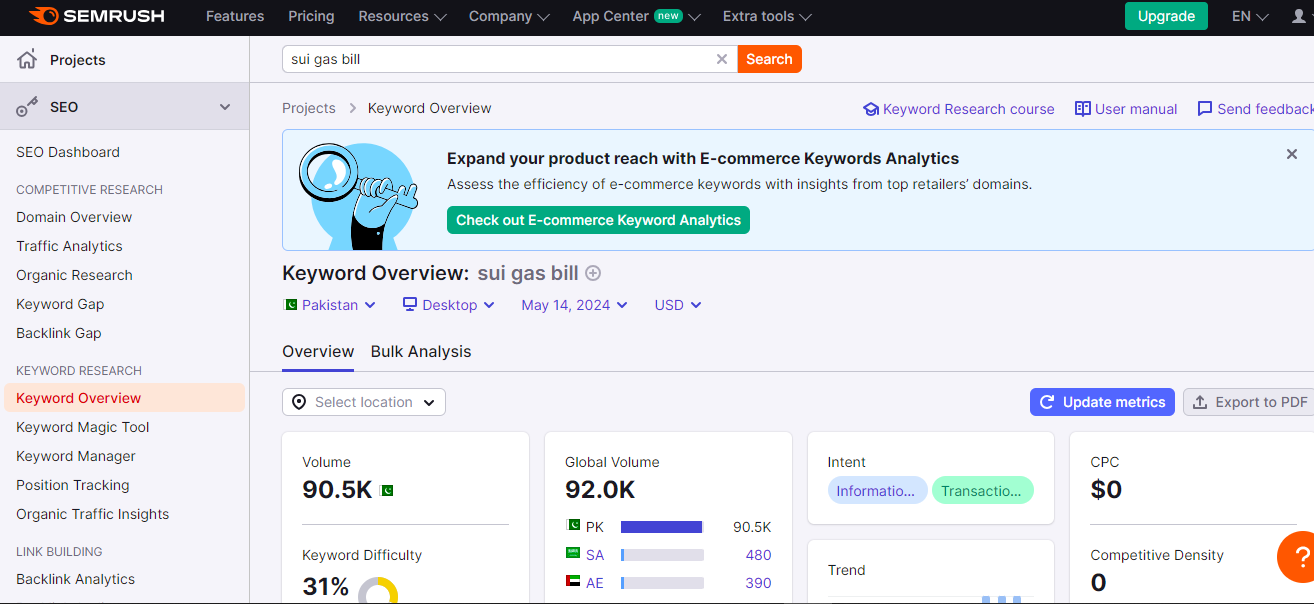
Hi there, Moz Community! I'm reaching out for some guidance on keyword research discrepancies. I'm currently targeting the keyword "sui gas bill" for my blog, sngplbill, which focuses on information related to Sui gas bills. I've used several keyword research tools, including Moz, Google Keyword Planner, Ahrefs, and Semrush, and each platform provides different search volume and keyword difficulty scores: Moz: No search volume data, Keyword Difficulty (KD) 24
Keyword Research | | Faizali.786
Google Keyword Planner: Search volume 100k-1M, Difficulty (Low)
Semrush: Search volume 90k, KD 31
Ahrefs: KD 1 (Very Easy)
These varying results are causing some confusion. Ideally, I'd like to understand which platform offers the most reliable data for search volume and keyword difficulty. Here are some additional details that might be helpful: My target location: Pakistan My Questions: What factors might contribute to these discrepancies in keyword data across different tools?
Considering my niche (Sui gas bill information in Pakistan), which platform would you recommend for the most accurate search volume and keyword difficulty estimates?
Are there any additional factors to consider beyond search volume and keyword difficulty when selecting keywords for content strategy?
Any insights you can provide would be greatly appreciated!
Capture sui gas bill semrush.PNG Capture moz sui gas bill.PNG Capture gkp sui gas bill.PNG Capture ahref sui gas bill.PNG
Thanks,0 -
Minor languages keyword research
Hello, I am in charge of doing a keyword research for several small countries in Europe, namely Hungary, Estonia and Latvia.
Keyword Research | | Lvet
I normally use the Keyword planner for Google Ads, but for Hungarian, Estonian and Latvian this tools seems to find no results for the keywords related to my websites. For example, in Hungarian the keyword "ajak toltoanyagok" ("lip fillers" in English) doesn't give any results (and yes, I am targeting my searches to Hungary and Hungarian). I have the same problems with Latvian and Estonian. Is there another tool that I could use and that could give me better results? Help! Cheers Luca rONwtZt0 -
A Solution to Keywords Being Grouped in Google Keyword Planner
Hi guys, I am trying to get search traffic for a list of keywords which I put together a few years ago for one of my clients, this was before Google made changes to their Keyword Planner. When I am adding the list into Google Keyword Planner it is "grouping" a number of the keywords/phrases together, and therefore removing 13 of the keywords from the original list of 59 keywords. Is there a way around this so I can get search volume for the original list, and not the cut down one? I am specifically using Google Keyword Planner as I want to get search volume for a number of specific locations in the UK. Any comments/feedback is greatly appreciated. Thanks in advance! Jack. I19Op
Keyword Research | | ChemistryMarketing1 -
How granular should I get with Keyword research?
I'm doing KW research for a new business. My understanding from KW research guides: Use tools to create a list of thousands of keywords Analyze difficulty and search volume Reduce your list and do on page optimization for your select KWs My dilemma with this approach is that it seems "keyword based" rather than "intent" or "category" based. e.g. Let's say I have a grocery store. Ignoring SEO, I know that these are my main categories: Produce Meat Dairy Canned Goods Baked Goods In other words, the above categories are the general "intents" and "categories" that I'd really want to rank for. Keyword tool shows that they have high volume and high difficulty. Let's say that after doing keyword research, I discover "Low Fat Chicken Breasts" and "Turkey Sausage" and "Cheap Meat Wholesale" have decent search volume and low competition. I don't quite understand how I'm supposed to utilize these fringe keywords in my on page SEO plan because it doesn't make sense as a human to categorize my site that way. Not sure if this is clear. Basically I'm trying to figure out if I should really be getting this granular on keywords to help guide my store categories or if I should just be picking broader terms.
Keyword Research | | clarasboutiqueusa0 -
Keywords with and without diacritics
Hi, I am trying to make my site to appear in the search results even the searched term have or have not been wrote with diacritics for example: "șarpe" or "sarpe". The language is Romanian. If I seach for "Românul cu maşină, marea victimă" or "Romanul cu masina, marea victima" the first result for both searches is the same. I don't see anything special on their html code and I am wondering how do they did it. Regards, Bogdan
Keyword Research | | RIAdig0 -
Keyword research tools
So I went to a panel a while back that said Wordtracker is basically useless. I'm not using it as an end-all, be-all, but more for insights and context. Do you agree with that statement? The hosting company provides a keyword research tool, so I wasn't sure how seriously to take it. Have you guys been using Bing for the search data previously provided by Google's Keyword Research Tool? Do you find that to be a viable resource? Thanks.
Keyword Research | | SSFCU0 -
Longtail keyword definition seems fuzzy?
So we all know about longtail keyword vs. short tail. However, it seems that the definition is a bit inconsistant. Some people say longtail keywords are keywords that get very low amounts of traffic, others that they are key phrases with 2 or more words. And others add to this that they have high conversion rate but describe specific features, product, service, model # etc. In an ideal model I suppose all of these things would be true. As keyword length increases, traffic tends to decrease, keyword is more specific pointing at features, model#, specific product etc and therefore the conversion rate is a bit higher as well. However, the data isn't a perfect curve. I will see keywords that get 18,000 searches but have 4 words. And then I will see single word key phrases that get <10 -20 searches a month. What am I to consider these? Its like they fit half the criteria. Any comments on this would be helpful and appreciated. I suppose the real question I am after is - it seems like the real definition of a long tail keyword cant be any of the above traits of a long tail keyword. How do you really define a long tail keyword in all circumstances (without it being this subjective idealized definition based on a perfect model) and where would the keyword circumstances (lots of words but high traffic, and low traffic but 1 word) fall in the graph? Center?
Keyword Research | | eastco0 -
Search Terms with Apostrophes
In doing keyword research I discovered that the Google Adwords Tools returns results with a space in search terms where an apostrophe should be. For example: Searching for 'mens fashion' or 'men's fashion' will return keyword ideas like 'men s fashion trends', 'men s fashion styles'. Same thing happens if yous search for '50s fashion' or 'mens suits'. Not only that but if you search for 'men s fashion' in the adwords tool you get 14,800 exact matches! Who would you use that term? And if you do search for it in Google, it will auto correct to 'men's fashion'. If you know the answer to what a term like 'men s fashion' signifies, you can skip the rest of this post and answer my question (thanks!). If not, here's what I did to try and figure it out - but I'm stuck and I need your help. First off, I did a search for all 3 terms: (mens fashion, men's fashion and men s fashion) in the adwords tool. The tool responded with different numbers for each, with 'men s fashion' far exceeding 'men's fashion'. See image 1 I did a search for each of the three terms in Google. The top 10 results for each were different. See image 2 Google reads 'men s fashion' as 'men's fashion'. I know that because: Google says 'showing result's for men's fashion' (obvious!) Google instant lists terms beginning with 'men's fashion...' See image 3 Related searches are identical for those two but not for 'mens fashion'. But it's not completely the same since as I mentioned you get different results, and the number of results found are different as well. So that brings me back to my question: When the tool says that 28 people search for [men's fashion] and 14,800 search for [men s fashion]. What on earth does it mean? bknQU tNKo7 C0P7S
Keyword Research | | 5225Marketing2