Moz Q&A is closed.
After more than 13 years, and tens of thousands of questions, Moz Q&A closed on 12th December 2024. Whilst we’re not completely removing the content - many posts will still be possible to view - we have locked both new posts and new replies. More details here.
Not all images indexed in Google
-
Hi all,
Recently, got an unusual issue with images in Google index. We have more than 1,500 images in our sitemap, but according to Search Console only 273 of those are indexed. If I check Google image search directly, I find more images in index, but still not all of them.
For example this post has 28 images and only 17 are indexed in Google image. This is happening to other posts as well.
Checked all possible reasons (missing alt, image as background, file size, fetch and render in Search Console), but none of these are relevant in our case. So, everything looks fine, but not all images are in index.
Any ideas on this issue?
Your feedback is much appreciated, thanks
-
Fetching, rendering, caching and indexing are all different. Sometimes they're all part of the same process, sometimes not. When Google 'indexes' images, that's primarily for its image search engine (Google Images). 'Indexing' something means that Google is listing that resource within its own search results for one reason or another. For the same reasons that Google rarely indexes all of your web-pages, Google also rarely indexes all of your images.
That doesn't mean that Google 'can't see' your images and has an imperfect view of your web-page. It simply means that Google does not believe the image which you have uploaded are 'worthy' enough to be served to an end-user who is performing a certain search on Google images. If you think that gaining normal web rankings is tricky, remember that most users only utilise Google images for certain (specific) reasons. Maybe they're trying to find a meme to add to their post on a form thread or as a comment on a Social network. Maybe they're looking for PNG icons to add into their PowerPoint presentations.
In general, images from the commercial web are... well, they're commercially driven (usually). When was the last time you expressedly set out to search for Ads to look at on Google images? Never? Ok then.
First Google will fetch a page or resource by visiting that page or resource's URL. If the resource or web-page is of moderate to high value, Google may then render the page or resource (Google doesn't always do this, but usually it's to get a good view of a page on the web which is important - yet which is heavily modified by something like JS or AJAX - and thus all the info isn't in the basic 'source code' / view-source).
Following this, Google may decide to cache the web-page or resource. Finally, if the page or resource is deemed worthy enough and Google's algorithm(s) decide that it could potentially satisfy a certain search query (or array thereof) - the resource or page may be indexed. All of this can occur in various patterns, e.g: indexing a resource without caching it or caching a resource without indexing it (there are many reasons for all of this which I won't get into now).
On the commercial web, many images are stock or boiler-plate visuals from suppliers. If Google already has the image you are supplying indexed at a higher resolution or at superior quality (factoring compression) and if your site is not a 'main contender' in terms of popularity and trust metrics, Google probably won't index that image on your site. Why would Google do so? It would just mean that when users performed an image search, they would see large panes of results which were all the same image. Users only have so much screen real-estate (especially with the advent of mobile browsing popularity). Seeing loads of the same picture at slightly different resolutions would just be annoying. People want to see a variety, a spread of things! **That being said **- your images are lush and I don't think they're stock rips!
If some images on your page, post or website are not indexed - it's not necessarily an 'issue' or 'error'.
Looking at the post you linked to: https://flothemes.com/best-lightroom-presets-photogs/
I can see that it sits on the "flothemes.com" domain. It has very strong link and trust metrics:
Ahrefs - Domain rating 83
Moz - Domain Authority - 62
As such, you'd think that most of these images would be unique (I don't have time to do a reverse image search on all of them) - also because the content seems really well done. I am pretty confident (though not certain) that quality and duplication are probably not to blame in this instance.
That makes me think, hmm maybe some of the images don't meet Google's compression standards.
Check out these results (https://gtmetrix.com/reports/flothemes.com/xZARSfi5) for the page / post you referenced, on GTMetrix (I find it superior to Google's Page-Speed Insights) and click on the "Waterfall" tab.
You can see that some of the image files have pretty lard 'bars' in terms of the total time it took to load in those individual resources. The main offenders are this image: https://l5vd03xwb5125jimp1nwab7r-wpengine.netdna-ssl.com/wp-content/uploads/2016/01/PhilChester-Portfolio-40.jpg (over 2 seconds to pull in by itself) and this one: https://l5vd03xwb5125jimp1nwab7r-wpengine.netdna-ssl.com/wp-content/uploads/2017/04/Portra-1601-Digital-2.png (around 1.7 seconds to pull in)
Check out the resource URLs. They're being pulled into your page, but they're not hosted on your website. As such - how could Google index those images for your site when they're pulled in externally? Maybe there's some CDN stuff going on here. Maybe Google is indexing some images on the CDN because it's faster and not from your base-domain. This really needs looking into in a lot more detail, but I smell the tails of something interesting there.
If images are deemed to be uncompressed or if their resolution is just way OTT (such that most users would never need even half of the full deployment resolution) - Google won't index those images. Why? Well they don't want Google Images to become a lag-fest I guess!
**Your main issue is that you are not serving 'scaled' images **(or apparently, optimising them). On that same GTMetrix report, check out the "PageSpeed" tab. Yeah, you scored an F by the way (that's a fail) and it's mainly down to your image deployment.
Google thinks one or more of the following:
- You haven't put enough effort into optimising some of your images
- Some of your images are not worth indexing or it can find them somewhere else
- Google is indexing some of the images from your CDN instead of your base domain
- Google is having trouble indexing images for your domain, which are permanently or temporarily stored off-site (and the interference is causing Google to just give up)
I know there's a lot to think about here, but I hope I have at least put you on the 'trail' a reasonable solution
This was fun to examine, so thanks for the interesting question!


Got a burning SEO question?
Subscribe to Moz Pro to gain full access to Q&A, answer questions, and ask your own.
Browse Questions
Explore more categories
-
Moz Tools
Chat with the community about the Moz tools.
-
SEO Tactics
Discuss the SEO process with fellow marketers
-
Community
Discuss industry events, jobs, and news!
-
Digital Marketing
Chat about tactics outside of SEO
-
Research & Trends
Dive into research and trends in the search industry.
-
Support
Connect on product support and feature requests.
Related Questions
-

My WP website got attack by malware & now my website site:www.example.ca shows about 43000 indexed page in google.
Hi All My wordpress website got attack by malware last week. It affected my index page in google badly. my typical site:example.ca shows about 130 indexed pages on google. Now it shows about 43000 indexed pages. I had my server company tech support scan my site and clean the malware yesterday. But it still shows the same number of indexed page on google.
Technical SEO | | ChophelDoes anybody had ever experience such situation and how did you fixed it. Looking for help. Thanks FILE HIT LIST:
{YARA}Spam_PHP_WPVCD_ContentInjection : /home/example/public_html/wp-includes/wp-tmp.php
{YARA}Backdoor_PHP_WPVCD_Deployer : /home/example/public_html/wp-includes/wp-vcd.php
{YARA}Backdoor_PHP_WPVCD_Deployer : /home/example/public_html/wp-content/themes/oceanwp.zip
{YARA}webshell_webshell_cnseay02_1 : /home/example2/public_html/content.php
{YARA}eval_post : /home/example2/public_html/wp-includes/63292236.php
{YARA}webshell_webshell_cnseay02_1 : /home/example3/public_html/content.php
{YARA}eval_post : /home/example4/public_html/wp-admin/28855846.php
{HEX}php.generic.malware.442 : /home/example5/public_html/wp-22.php
{HEX}php.generic.cav7.421 : /home/example5/public_html/SEUN.php
{HEX}php.generic.malware.442 : /home/example5/public_html/Webhook.php0 -

Google Indexed a version of my site w/ MX record subdomain
We're doing a site audit and found "internal" links to a page in search console that appear to be from a subdomain of our site based on our MX record. We use Google Mail internally. The links ultimately redirect to our correct preferred subdomain "www", but I am concerned as to why this is happening and if it can have any negative SEO implications. Example of one of the links: Links aspmx3.googlemail.com.sullivansolarpower.com/about/solar-power-blog/daniel-sullivan/renewable-energy-and-electric-cars-are-not-political-footballs I did a site operator search, site:aspmx3.googlemail.com.sullivansolarpower.com on google and it returns several results.
Technical SEO | | SS.Digital0 -

Indexed pages
Just started a site audit and trying to determine the number of pages on a client site and whether there are more pages being indexed than actually exist. I've used four tools and got four very different answers... Google Search Console: 237 indexed pages Google search using site command: 468 results MOZ site crawl: 1013 unique URLs Screaming Frog: 183 page titles, 187 URIs (note this is a free licence, but should cut off at 500) Can anyone shed any light on why they differ so much? And where lies the truth?
Technical SEO | | muzzmoz1 -

How preproduction website is getting indexed in Google.
Hi team, Can anybody please help me to find how my preproduction website and urls are getting indexed in Google.
Technical SEO | | nlogix0 -
Does Google index internal anchors as separate pages?
Hi, Back in September, I added a function that sets an anchor on each subheading (h[2-6]) and creates a Table of content that links to each of those anchors. These anchors did show up in the SERPs as JumpTo Links. Fine. Back then I also changed the canonicals to a slightly different structur and meanwhile there was some massive increase in the number of indexed pages - WAY over the top - which has since been fixed by removing (410) a complete section of the site. However ... there are still ~34.000 pages indexed to what really are more like 4.000 plus (all properly canonicalised). Naturally I am wondering, what google thinks it is indexing. The number is just way of and quite inexplainable. So I was wondering: Does Google save JumpTo links as unique pages? Also, does anybody know any method of actually getting all the pages in the google index? (Not actually existing sites via Screaming Frog etc, but actual pages in the index - all methods I found sadly do not work.) Finally: Does somebody have any other explanation for the incongruency in indexed vs. actual pages? Thanks for your replies! Nico
Technical SEO | | netzkern_AG0 -
Image Indexing Issue by Google
Hello All,My URL is: www.thesalebox.comI have Submitted my image Sitemap in google webmaster tool on 10th Oct 2013,Still google could not indexing any of my web images,Please refer my sitemap - www.thesalebox.com/AppliancesHomeEntertainment.xml and www.thesalebox.com/Hardware.xmland my webmaster status and image indexing status are below,
Technical SEO | | CommercePundit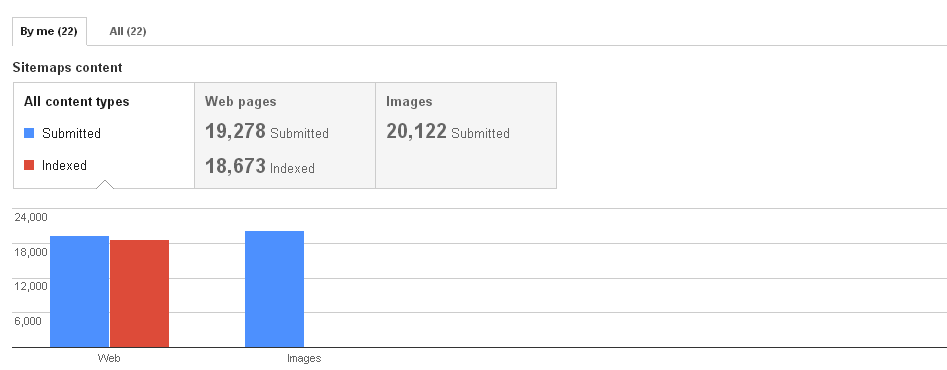 Can you please help me, why my images are not indexing in google yet? is there any issue? please give me suggestions?Thanks!
0
Can you please help me, why my images are not indexing in google yet? is there any issue? please give me suggestions?Thanks!
0 -

Google is indexing my directories
I'm sure this has been asked before, but I was looking at all of Google's results for my site and I found dozens of results for directories such as: Index of /scouting/blog/wp-includes/js/swfupload/plugins Obviously I don't want those indexed. How do I prevent Google from indexing those? Also, it only seems to be doing it with Wordpress, not any of the directories on my main site. (We have a wordpress blog, which is only a portion of the site)
Technical SEO | | UnderRugSwept0 -

Dynamically-generated .PDF files, instead of normal pages, indexed by and ranking in Google
Hi, I come across a tough problem. I am working on an online-store website which contains the functionlaity of viewing products details in .PDF format (by the way, the website is built on Joomla CMS), now when I search my site's name in Google, the SERP simply displays my .PDF files in the first couple positions (shown in normal .PDF files format: [PDF]...)and I cannot find the normal pages there on SERP #1 unless I search the full site domain in Google. I really don't want this! Would you please tell me how to figure the problem out and solve it. I can actually remove the corresponding component (Virtuemart) that are in charge of generating the .PDF files. Now I am trying to redirect all the .PDF pages ranking in Google to a 404 page and remove the functionality, I plan to regenerate a sitemap of my site and submit it to Google, will it be working for me? I really appreciate that if you could help solve this problem. Thanks very much. Sincerely SEOmoz Pro Member
Technical SEO | | fugu0


