Moz Q&A is closed.
After more than 13 years, and tens of thousands of questions, Moz Q&A closed on 12th December 2024. Whilst we’re not completely removing the content - many posts will still be possible to view - we have locked both new posts and new replies. More details here.
Why Product pages are throwing Missing field "image" and Missing field "price" in Wordpress Woocommerce
-
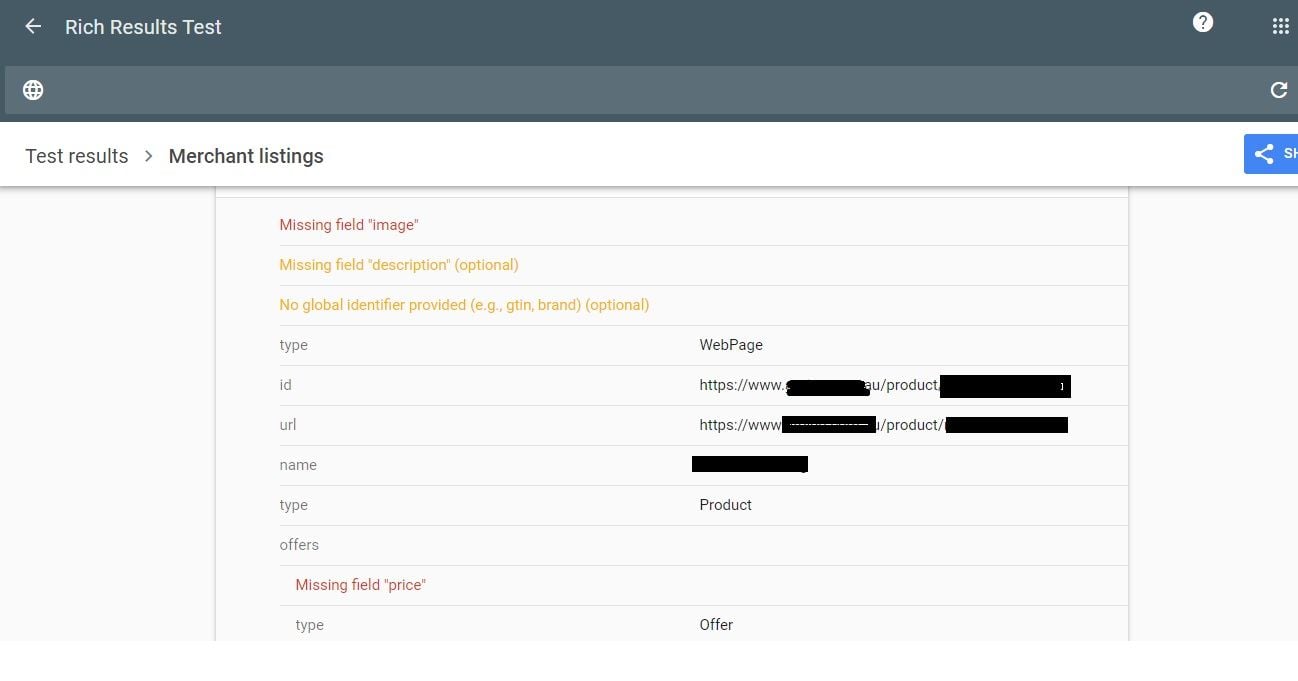
I have a wordpress wocommerce website where I have uploaded 100s of products but it's giving me error in GSC under merchant listing tab. When I tested it show missing field image and missing field price. I have done everything according to https://developers.google.com/search/docs/appearance/structured-data/product#merchant-listing-experiences and applied fixed i.e. images are 800x800 and price range is also there. What else can be done here?!
-
The "Missing field 'image' and 'price'" errors in WordPress WooCommerce product pages typically indicate that some product listings are incomplete or lacking essential information. To resolve this, ensure that you have properly configured product images and prices for all your items in the WooCommerce backend. This will help provide a better shopping experience for your customers. If you need more guidance on how to fix these issues, please let me know.
-
Hey, it sounds like there might be a configuration issue with the product pages. Have you checked if the 'image' and 'price' fields are properly Nedbank Branch Code filled for each product in the WooCommerce settings? Double-checking those might solve the problem. Let me know how it goes!
-
I'm sorry to hear about the trouble you're facing. This issue might stem from incomplete product listings in your WooCommerce setup. Ensure that each product has a designated image and price specified. Also, double-check any custom fields or plugins that might affect this. If the problem persists, Nedbank Branch Code reaching out to WooCommerce support or consulting the community forums could provide further assistance. Good luck!
-
I'm sorry to hear about the trouble you're facing. It sounds like you've followed the structured data guidelines correctly. Double-check that there are no typos or discrepancies in your code. Also, ensure your website is properly indexed by Google. If the issue persists, consider reaching out to Google Support for more specific guidance. Good luck getting it sorted!

Got a burning SEO question?
Subscribe to Moz Pro to gain full access to Q&A, answer questions, and ask your own.
Browse Questions
Explore more categories
-
Moz Tools
Chat with the community about the Moz tools.
-
SEO Tactics
Discuss the SEO process with fellow marketers
-
Community
Discuss industry events, jobs, and news!
-
Digital Marketing
Chat about tactics outside of SEO
-
Research & Trends
Dive into research and trends in the search industry.
-
Support
Connect on product support and feature requests.
Related Questions
-
site speed
i use mid-quality pic and... but my site speed is low
On-Page Optimization | | zlbvasgabc
any suggestion?
my site is:
https://bandolini.ir/0 -
Strange Traffic Movements
Hi there, I'm wondering if anyone can shed some light on this... I'm working with a client whose website is experiencing some odd organic traffic patterns. See screenshot attached. As you can see, there was a sudden cliff fall about a month ago, and then it recovered (almost) entirely. Then, a month to the day later, the same thing happened again. What is the likelihood that this is a data glitch vs an algorithm thing? Any light you can shed on this would be appreciated. Thanks,
Search Behavior | | mhenshall
Marc
Screenshot 2023-08-18 at 09.37.26.png image url)0 -
English pages given preference over local language
We recently launched a new design of our website and for SEO purposes we decided to have our website both in English and in Dutch. However, when I look at the rankings in MOZ for many of our keywords, it seems the English pages are being preferred over the Dutch ones. That never used to be the case when we had our website in the old design. It mainly is for pages that have an English keyword attached to them, but even then the Dutch page would just rank. I'm trying to figure out why English pages are being preferred now and whether that could actually damage our rankings, as search engines would prefer copy in the local language. An example is this page: https://www.bluebillywig.com/nl/html5-video-player/ for the keywords "HTML5 player" and "HTML5 video player".
Local SEO | | Billywig0 -
Need some help understanding SEO - Please help before I lose [pull out] all my hair
I'm new to SEO, and am stubbornly trying to educate myself. I have a telescope shop in Canada, it's a small business that we run on the side. We're driving lots of traffic through FB and our outreach programs but I really want to increase our presence on search. We released a new website back in January and it killed some of our rankings. We're working our way back with a very specific set of efforts on regular SEO: Metadata and titles, although it seems that's not super relevant Building high quality backlinks and eliminating any spammy backlinks Rewriting product listings so that they are original content though I'm not sure how important this is in e-commerce Writing high quality articles and blog posts Working relevant keywords into our product pages and titles I understand that good SEO is about pushing on all the levers, and trying to make sure that your site is as valuable to the end user as possible. We're making some good progress, but I'm puzzled by the #1 shop in Canada. They don't put any apparent effort into SEO and they still rank #1 on every key product we compete with them on. I've worked with two separate, highly ranked and regarded SEO firms on this and neither has been able to tell my why this other site ranks so highly. Here's a specific example on a popular product that we both sell, the Celestron NexStar 8SE. Here’s the link to Telescope Canada’s page for their Celestron 8SE: https://telescopescanada.ca/products/celestron-nexstar-8se-computerized-telescope-11069 Here’s a link to the Celestron 8SE page from the manufacturer website: https://www.celestron.com/products/nexstar-8se-computerized-telescope Telescopes Canada has just copied and pasted. There is no original content aside from adding the shipping and return policy to the tab, and having some options for selecting accessories on the page. Here is our page: https://all-startelescope.com/products/celestron-nexstar-8se We have higher page authority, higher domain authority, and they keyword analyzer in moz says that our page is higher quality than the Telescopes Canada page. I can’t find a single metric on any tool (ubbersuggest, Moz, ahrefs, semrush) that says Telescopes Canada is a better site, or has a better NexStar 8SE product page. But they keep ranking ahead of us, and right at the top of google search. Our titles are good, our metadata is good (but I don’t think that’s been a serious ranking factor for about ten years). Our text is original, it’s relevant, we have healthy internal links to the page. According to Moz's page ranker it's 20 points higher than Telescope Canada's page. We have invensted in some excellent blog content, we’re adding new products to the website so that we rank for more keywords. All of those things are helping, but I fundamentally don’t understand why Telescopes Canada is #1 almost across the board on every key product in our market. There is something that I’m not seeing here. Can you see any metric, any tool in your toolbox that indicates why they rank at the top, or even higher than we do for in these search terms specific to that product: Celestron NexStar 8SE
Intermediate & Advanced SEO | | nkennett
NexStar 8SE
Celestron NexStar 8SE Canada
NexStar 8SE Canada I have a feeling it's something technical that I'm missing, but I'm not sure how obvious it is with two 'professional' firms not finding it. I'd really appreciate any help or insight that you can offer.0 -
Assigning WooCommerce products to more than one category - Correct methodology?
I manage a store selling prescription glasses, many of which are unisex or apply to more than one category. I have already assigned the canonical URL for each category, but my question is, if a product appears in more than one category, do I need to set the canonical URL in each product to reflect the category I want it to index under? Therefore, any additional categories that product appears in simply refers the link value back to the canonical URL. I note that in Yoast, under each product, there's note in the canonical setting to leave it empty to default to permalink, so this has confused me a little. I'm just concerned that by applying a product to multiple categories, it may be causing duplicate content, as I have a lot of duplicate issues which I'll raise in another question. Thanks!
Technical SEO | | SushiUK1 -
Why do some URLs for a specific client have "/index.shtml"?
Reviewing our client's URLs for a 301 redirect strategy, we have noticed that many URLs have "/index.shtml." The part we don'd understand is these URLs aren't the homepage and they have multiple folders followed by "/index.shtml" Does anyone happen to know why this may be occurring? Is there any SEO value in keeping the "/index.shtml" in the URL?
Technical SEO | | FranFerrara0 -
Rel="external"
Hi all, I got a link and its off a site and marked up with rel="external". Is this a followed or nofollowed link? Does it pass link juice? Thanks
Technical SEO | | Sharer0